
What is a channel?
A channel, sometimes known as a casing, is a separate piece of fabric (or it can be a turn-back hem) that drawstring or elastic can be fed through. You can sew them to the inside or outside of the garment and can be placed anywhere - you’ll find them on sleeves, hems, waistlines and waistbands.
Before you start
Add volume to your pattern in the desired place. Consider if you’re adding volume through the whole panel or just to one area of the pattern
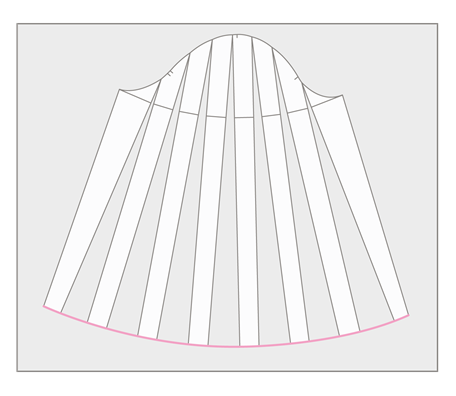
Creating a channel tutorial
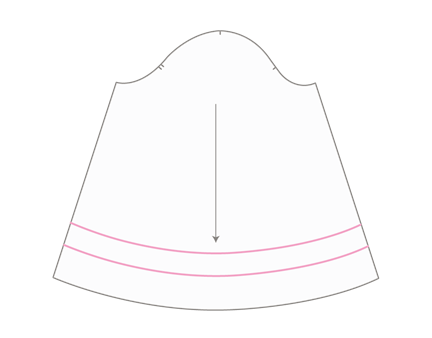
1. Prepare the channel shape
Draw the desired channel shape onto the pattern.
To get a consistent-height channel, draw one side and use a pattern master to draw a parallel line at the channel height.
Alternatively, draw any shape onto your pattern to create a decorative shaped channel.
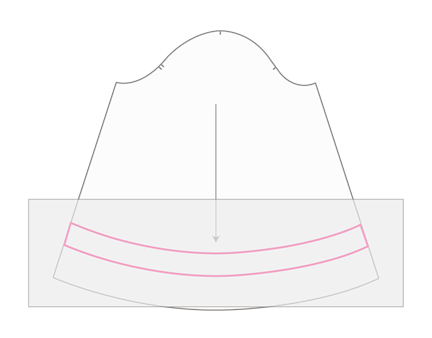
2. Trace the shape
Lay paper on top of the pattern and trace off the channel shape.
If the channel goes across a seam, join the two pieces by placing them together at the stitch line (without seam allowance) of the seam.
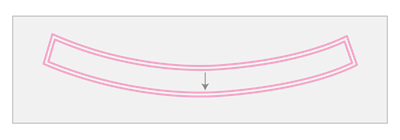
3. Finish the pattern
Add seam allowance all the way around. If any sections are cut on the fold, trace a full pattern instead of cut on fold, as it will keep the shape accurate.
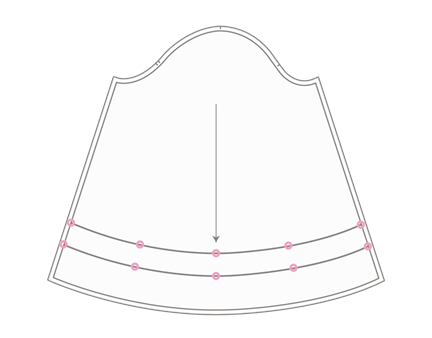
4. Add channel position
Keep the channel marked on the pattern as a reference for placement. Add drill holes on the pattern at the edges to help you transfer the channel position onto the fabric when sewing.
Examples of channel designs

In this example, I opened up the pattern from the hem to nothing at the neckline and shoulder. Then I drew on the channel and traced a copy.
I sewed it to the back of the fabric and in this case, I left the side seams open for the drawstring to come out. However, you could also add buttonholes (before stitching the channel) so the drawstring can appear on the front piece. See the example below.
Below is the pattern for the photo above.


In this example, I’ve added a channel to the body, with the drawstrings coming out at the side seams and I’ve also added a channel to the sleeve as well! (It would look better with an arm in it!) You can see the pattern for the sleeve below.


Volume has been added to the side seams (to nothing at the centre front and centre back. This means the CF and CB become curved and therefore need a seam added.) Then a channel is added, fixed at the top and adjustable at the bottom. You can see the pattern below.


In this example, I have cut away the back by drawing a design line.
Then added gather through the bottom panel - I first opened up the pattern evenly at the top and bottom to ensure there’s volume at the channel opening and the hem. Then I added extra flare to add width in the hem. You could add it all evenly throughout; however, there will be more fabric bulk at the opening.
It is gathered by a channel (also used to finish the top edge) and then elastic is added so it can be stretched to get on and off. Or you could use a facing and fix the gather but you’d need to add a side zip to get in and out.
I hope you enjoyed this tutorial. 💕
If you'd like to learn more about adding volume to patterns, check out Intro to Pattern Making, where we get into the why behind the how of the core techniques, plus loads of designer examples to help you apply these skills to your own designs.